I. Cranhill, Glasgow, 1955
Angus McKinnon Young was born on 31 March 1955 in Cranhill, a working-class district of Glasgow where unemployment was high, the winters were brutal, and the streets taught you how to fight before they taught you anything else. His father William had served as a flight engine mechanic in the RAF during World War II and came home to work as a postman. His mother Margaret raised eight children in a terraced house at 6 Skerryvore Road. Music ran through all of them. Brother George would go on to co-found the Easybeats. Brother Malcolm would co-found AC/DC. Brother Alexander was an accomplished singer and saxophonist who left for a music career in Europe. And Angus — the youngest, the smallest, the scrappiest — picked up a guitar at the age of five or six, received exactly one lesson from Alexander, and then taught himself everything else.
In the winter of 1962–63 — the worst winter on record in Scotland — the family made a decision. Australian television was running advertisements offering assisted passage to families willing to emigrate. The Youngs took the deal. In June 1963, when Angus was eight years old, the family flew from Glasgow to Sydney, Australia. They stayed initially at the Villawood Migrant Hostel in Nissen huts — the same site later developed as the Villawood Immigration Detention Centre — before settling in a semi-detached house at 4 Burleigh Street, Burwood. That house was demolished in December 2024, despite being on the National Trust's List of Historic Homes since 2013. The neighbourhood that made Angus Young is gone. The music it produced is not.
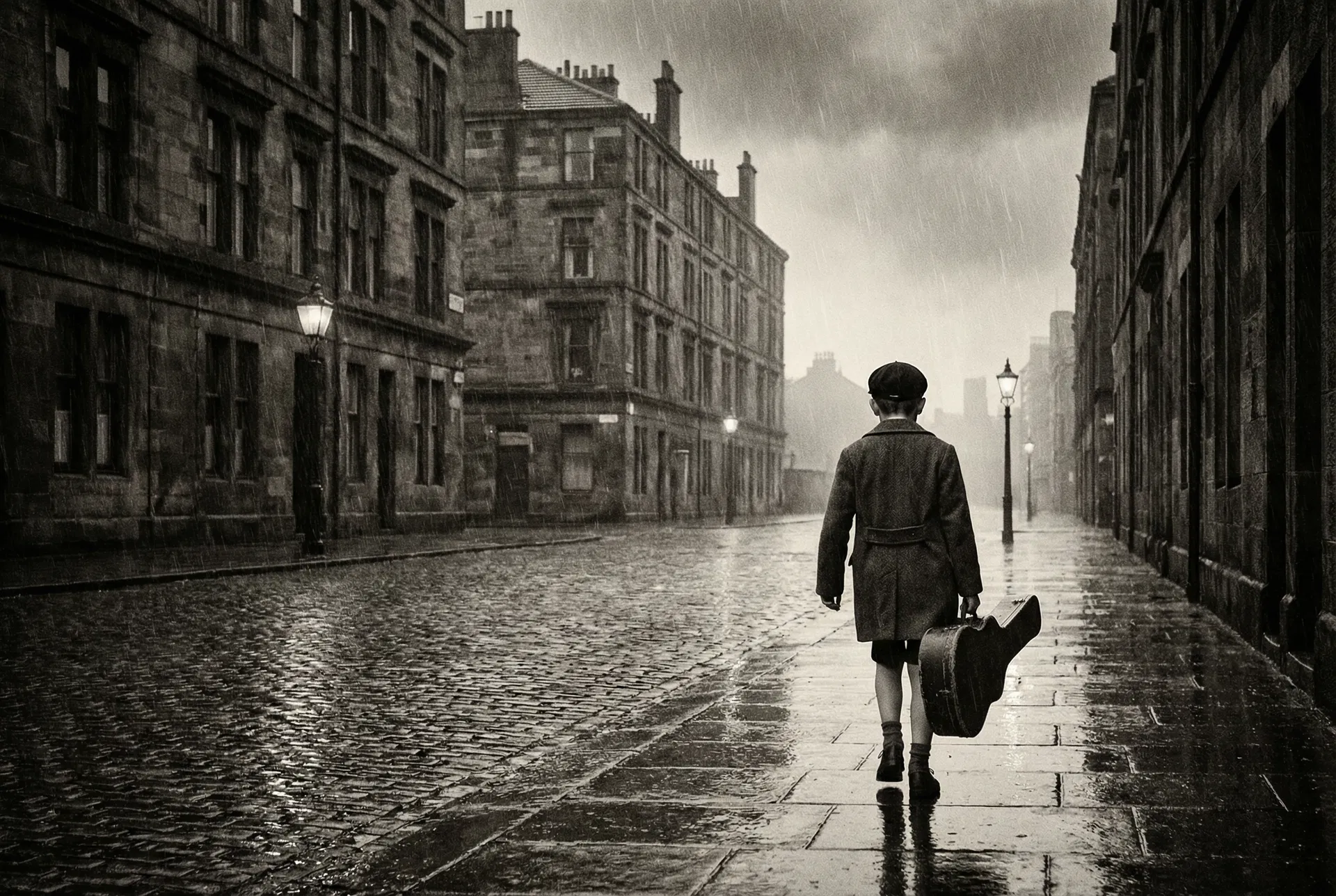
Cranhill, Glasgow. The winter of 1962–63 was the worst on record in Scotland. The Youngs left that June. Angus was eight. He brought the guitar.
II. The Uniform, the SG, and the Name on the Sewing Machine
AC/DC was formed in Sydney in November 1973 by Angus and his brother Malcolm. Angus was eighteen. He was still attending Ashfield Boys High School. The band's name came from sister Margaret, who spotted "AC/DC" printed on the back of a sewing machine. The schoolboy uniform — blazer, shorts, cap, tie, white shirt — also came from Margaret. She handed Angus his school clothes one day when he was heading to rehearsal, and something clicked. He tried a Superman costume. He tried a gorilla suit. Both got in the way of playing. The school uniform fit perfectly. It has fit perfectly for fifty years.
The guitar was a Gibson SG — cherry red, double cutaway, the instrument that would become as synonymous with Angus as the uniform itself. No effects pedals. No digital processing. Straight into a Marshall stack, turned up until the room shook. His style was rooted in Chuck Berry's duckwalk and the blues of B.B. King and Muddy Waters, filtered through something entirely his own: a ferocity of attack, a sustain that seemed to defy physics, and a stage presence that suggested a man who had been plugged directly into a power station.
The original singer was Dave Evans. He was replaced in 1974 by Ronald Belford "Bon" Scott — a Scottish-born Australian with a voice like gravel and whisky, a laugh that could fill a stadium, and a gift for writing lyrics that were simultaneously filthy, funny, and somehow profound. The classic AC/DC lineup was now in place: the Young brothers, Bon Scott, Phil Rudd on drums, and Cliff Williams on bass.
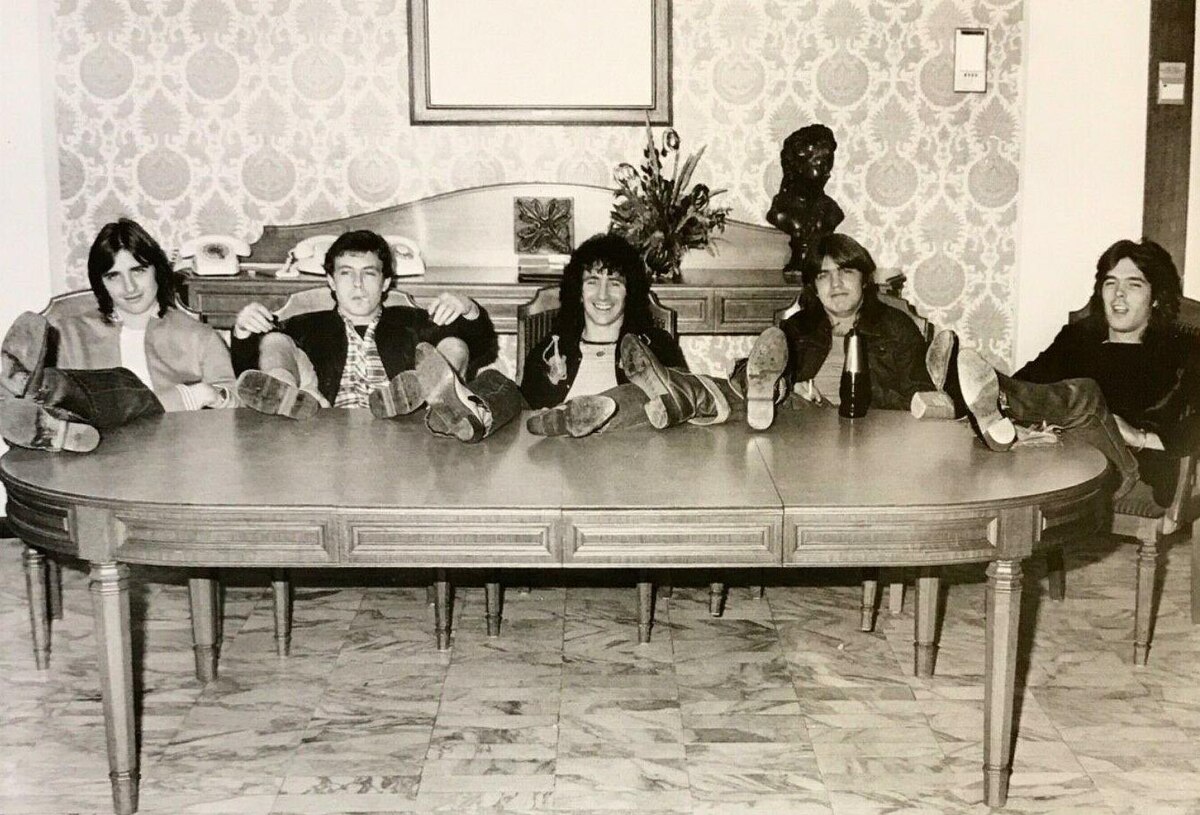
AC/DC, 1977. The Let There Be Rock era. Left to right: Phil Rudd, Bon Scott, Angus Young, Malcolm Young, Cliff Williams. Photograph: Atco Records publicity photo (public domain).
III. Highway to Hell — and the Night Everything Changed
Between 1975 and 1979, AC/DC released six albums and built a reputation as the hardest-working live band on earth. High Voltage. Dirty Deeds Done Dirt Cheap. Let There Be Rock. Powerage. Each one harder, louder, more relentless than the last. Then came Highway to Hell in 1979 — produced by Mutt Lange, the record that finally cracked the international market. It reached #17 on the US Billboard chart. For the first time, the world was paying attention.
Seven months after its release, on 19 February 1980, Bon Scott was found dead in a car in London. He was 33. The cause was acute alcohol poisoning. He had been out drinking the night before and never woke up. The band was in the middle of writing the follow-up album.
The question was simple and devastating: do you continue? Malcolm and Angus had lost their singer, their co-writer, and one of their closest friends. Their manager and producer urged them to go on. Two days after Bon's funeral, on 1 March 1980, AC/DC were back in rehearsal. They auditioned singers. Brian Johnson — the frontman of Geordie, a Newcastle band Bon Scott had admired — came in and sang "Whole Lotta Rosie" and "Nuthin' Yet." Angus said he reminded him of Bon. Johnson got the job.
IV. Back in Black — The Second Best-Selling Album of All Time
Back in Black was recorded in five weeks at Compass Point Studios in Nassau, Bahamas. It was released on 25 July 1980 — five months and one day after Bon Scott died. The cover was all black. No band name. No text. A tribute so stark it needed no explanation.
The opening track is "Hells Bells." A single tolling bell. Then the riff. If you have ever heard it, you know exactly what it sounds like. If you have ever heard it loud, in a car, or at a concert, or alone at midnight, you know what it does to you. It is one of the most recognizable album openings in the history of recorded music — and it was written by a band that had just buried their singer and decided to keep going anyway.
Back in Black has sold approximately 50 million copies. It is the second best-selling album of all time, behind only Michael Jackson's Thriller. The follow-up, For Those About to Rock (We Salute You), was their first album to reach #1 on the Billboard 200. AC/DC were now the biggest rock band on earth.

Back in Black, 1980. All-black cover. No band name. No text. A tribute so stark it needed no explanation. The second best-selling album of all time.
V. The Machine That Never Stopped
What followed was four decades of relentless output. The Razors Edge in 1990 gave the world "Thunderstruck" — a song that has been played at every sporting event on earth and shows no signs of stopping. Black Ice in 2008 was the second highest-selling record of that year. The band was inducted into the Rock and Roll Hall of Fame in 2003. In 2023, Rolling Stone ranked Angus #38 on their list of the 250 greatest guitarists of all time.
Through all of it, Angus Young never changed. The uniform. The SG. The duckwalk. The windmill. The same three chords, played with a conviction that makes every other guitarist in the world feel slightly inadequate. He doesn't drink. He doesn't do drugs. The wild man on stage is entirely natural — a man who has simply found the thing he was put on earth to do and has been doing it, without interruption, for fifty years.
He married Ellen van Lochem in 1980 — the same year Back in Black was released — and they have been together ever since. They live in the Netherlands. Ellen is Dutch. They have no children. Angus is, by all accounts, extraordinarily private off-stage. The man who throws himself across stadium stages in front of eighty thousand people goes home to a quiet house in the Dutch countryside and plays guitar.

Angus Young, St. Paul, Minnesota, November 23, 2008. The Black Ice tour. Photograph: Wikimedia Commons / CC BY-SA 3.0.
VI. Malcolm — The Backbone
In 2014, Malcolm Young — Angus's brother, co-founder, rhythm guitarist, and the engine room of everything AC/DC had ever done — was diagnosed with early-onset dementia. He retired from the band. His nephew Stevie Young, Stephen's son, took his place on rhythm guitar. Malcolm died on 18 November 2017, aged 64.
Angus has spoken about Malcolm with a reverence that is rare in rock and roll, a world not known for its sentimentality. "Malcolm was the backbone of AC/DC," he said. "Without him, there is no band." Malcolm wrote the riffs. Malcolm held the band together through every crisis — Bon's death, Brian's hearing loss, Phil Rudd's legal troubles, the endless lineup changes. Malcolm was the one who said, two days after Bon's funeral, that they were going back into rehearsal. Malcolm was the one who kept going.
When AC/DC released Power Up in November 2020 — their seventeenth studio album, recorded using riffs Malcolm had written before his illness — it debuted at #1 in more than twenty countries. It was dedicated to Malcolm. It proved, definitively, that the machine was still running. That it would always run. That Angus Young, at 65, in a schoolboy uniform, with a cherry red Gibson SG, was still the most compelling figure in rock and roll.
VII. Wembley, 2024. Age 69. Still the Duckwalk.
In the summer of 2024, AC/DC played Wembley Stadium. Angus Young was 69 years old. He walked on stage in the schoolboy uniform — the same uniform he has worn since 1973, the same one his sister Margaret handed him before a rehearsal fifty-one years ago — and he did the duckwalk. He did the windmill. He threw himself across the stage with the same ferocity he had at eighteen, at thirty, at fifty. The crowd of 90,000 people lost their minds.
There is a photograph from that night — the one at the top of this article — that captures something essential about Angus Young. He is mid-performance, guitar raised, face contorted with effort and joy. He looks like a man who has been doing exactly this, in exactly this uniform, for exactly this reason, his entire life. Because he has. Because he will.
He turned 70 on 31 March 2025. There is no indication he intends to stop.

Angus Young, Wembley Stadium, 3 July 2024. Age 69. Still the duckwalk. Photograph: Wikimedia Commons / CC BY-SA 2.0.
Gerald's Take
I have been thinking about what makes Angus Young's story a Best Days Ever story, and I keep coming back to the same thing: it is not the records sold, or the stadiums filled, or the Rock and Roll Hall of Fame induction. It is the fact that he never stopped. Not when Bon died. Not when Malcolm got sick. Not when the music industry changed around him, when grunge arrived and then died, when streaming replaced CDs, when the world moved on and then moved back again. He just kept going. In the same uniform. With the same guitar. Playing the same three chords with the same absolute conviction that this — right here, right now, in front of you — is the most important thing happening on earth.
That is not stubbornness. That is not nostalgia. That is a man who found his best days at eighteen and has been living them ever since. The schoolboy who never grew up. The guitarist who never stopped. The kid from Cranhill who flew to Sydney with a guitar and a family that believed in music, and turned it into 200 million records and a duckwalk that will outlast all of us.
Best Days Ever. Every single night. For fifty years.
The Albums — A Timeline
| Year | Album | Note |
|---|---|---|
| 1975 | High Voltage | Australian debut. The beginning. |
| 1976 | Dirty Deeds Done Dirt Cheap | Bon Scott at his most gloriously unhinged. |
| 1977 | Let There Be Rock | The riff machine finds its stride. |
| 1978 | Powerage | Angus's personal favourite. |
| 1979 | Highway to Hell | International breakthrough. Bon's last album. |
| 1980 | Back in Black ★ | Second best-selling album of all time. ~50 million copies. |
| 1981 | For Those About to Rock | First #1 on Billboard 200. |
| 1990 | The Razors Edge | Thunderstruck. Commercial resurgence. |
| 2008 | Black Ice | Second highest-selling record of 2008. |
| 2014 | Rock or Bust | First without Malcolm. Stevie Young steps in. |
| 2020 | Power Up ★ | Dedicated to Malcolm. #1 in 20+ countries. |
Fast Facts
Sources & Further Reading
- Wikipedia — Angus Young (en.wikipedia.org/wiki/Angus_Young)
- Wikipedia — AC/DC (en.wikipedia.org/wiki/AC/DC)
- Wikipedia — Back in Black (en.wikipedia.org/wiki/Back_in_Black)
- Guitar World — "Angus Young on life in the world's biggest rock band" (2020)
- Loudwire — "Why Does Angus Young Wear the Schoolboy Outfit?" (2023)
- Louder Sound — "AC/DC: the story behind Back in Black" (2025)
- Rolling Stone — 250 Greatest Guitarists of All Time (2023)
- Rock and Roll Hall of Fame — AC/DC inductee biography (2003)
- Photographs: Wikimedia Commons (CC BY-SA 2.0 / CC BY-SA 3.0)