Tiffany & Co.
The Blue Box, the Yellow Diamond, and the Long Road Back
There is a colour that does not exist in nature. It is not the blue of the sky, or the sea, or a summer morning in the Rockies. It is a very specific robin's egg hue — Pantone 1837 Blue — and it belongs, exclusively and by trademark, to a jewellery company founded in 1837 by a 25-year-old from Connecticut who opened a fancy goods store on Broadway and took in $4.98 on his first day. That colour is now one of the most recognisable in the world. And the story of how it got there — and nearly didn't — is one of the great dramas of American commerce.
Charles Lewis Tiffany was not, at the outset, a jeweller. He sold stationery. He sold fancy goods. He sold the kind of things that a young New Yorker with taste and ambition might want to put in a shop window to attract the attention of people with more money than he had. But he had a gift — not for gems, not yet, but for understanding what luxury meant to people who had never had it before. America in 1837 was not a country with an established aristocracy. It was a country that wanted one. Tiffany understood that instinct before anyone else did, and he spent the next sixty years building the institution that would satisfy it.
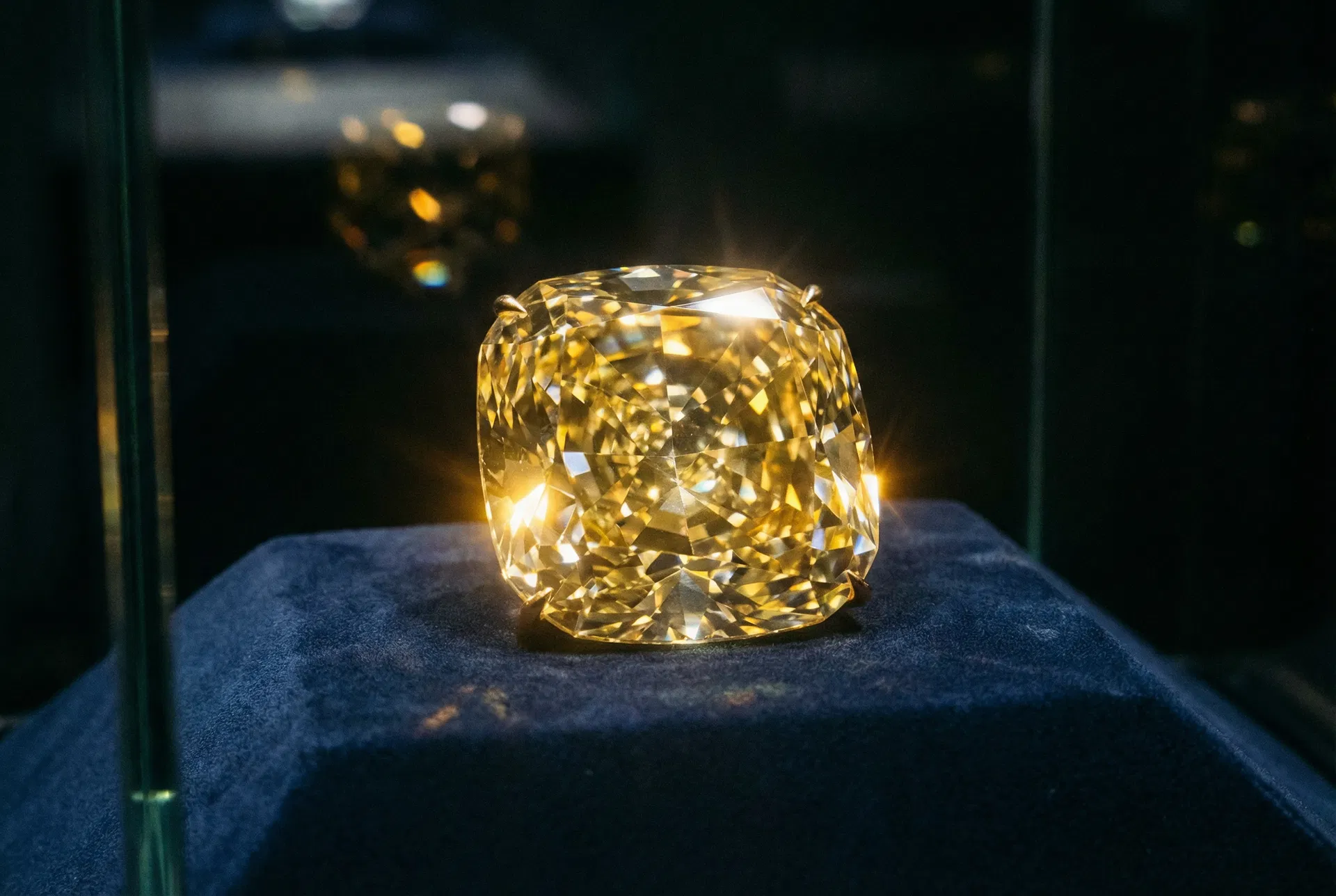
By 1853, he had bought out his partner and renamed the business Tiffany & Co. By 1878, he had acquired an extraordinary 278.42-carat rough yellow diamond from a South African mine — the largest fancy yellow diamond ever found at that point — and had it cut into the 128.54-carat cushion-brilliant stone that now sits in a glass case in the Fifth Avenue flagship, on display to anyone who walks in off the street. By 1886, he had invented the Tiffany Setting — the six-prong solitaire engagement ring that lifted the diamond above the band and let the light through — and changed the way the Western world proposed marriage. The setting is still in production. It has never been improved upon, because it cannot be.
The Colour That Built an Empire
The blue came later. Charles Lewis Tiffany chose it for his Blue Book catalogue — the first direct-mail jewellery catalogue in American history, launched in 1845 — and it stuck. Not because anyone decreed it should, but because it worked. The colour communicated something that words could not quite manage: a combination of restraint, confidence, and the particular kind of elegance that does not need to announce itself. When Tiffany trademarked it in 1998, they were not being proprietary so much as acknowledging what had already been true for a century. The colour was theirs. It had always been theirs.
In 1940, the company moved to its current address at the corner of Fifth Avenue and 57th Street. The building was designed to be seen from the street — the windows lit at night, the awnings in that unmistakeable blue, the whole facade a kind of promise. In 1961, Audrey Hepburn stood in front of those windows in a black Givenchy gown, eating a croissant and drinking coffee from a paper cup, and the film that opened with that image — Breakfast at Tiffany's — cemented the store's place in the cultural imagination of the entire world. Holly Golightly was not a wealthy woman. She was a woman who wanted to be. And Tiffany's was where she went when the world felt too much. "Nothing very bad could happen to you there," she says in the film. That line sold more jewellery than any advertisement Tiffany ever ran.
128.54 Carats of Uninterrupted History
The Tiffany Yellow Diamond has been worn by four women in nearly 150 years. Mrs. Sheldon Whitehouse wore it at the 1957 Tiffany Ball. Audrey Hepburn wore it for publicity photographs in 1961 — the only time she wore real jewellery for a role, though the diamond never appeared in the film itself. Lady Gaga wore it to the 2019 Academy Awards, suspended from a necklace of white diamonds that weighed more than the stone itself. And in 2021, Beyoncé wore it for the first LVMH-era Tiffany campaign — the first Black woman to do so — in an image that ran alongside Jean-Michel Basquiat's painting Equals Pi, its blue background a deliberate echo of the Blue Box.
"Four women in 150 years. That is not scarcity as a marketing strategy. That is scarcity as a statement of intent."
The diamond is not for sale. It has never been for sale. It sits in the flagship store, in a case, and you can walk in and look at it for free. That is either the most generous thing a luxury brand has ever done, or the most brilliant piece of marketing in retail history. Possibly both.
The Trouble with Being Iconic
There is a particular kind of problem that only the most successful brands ever have to face: the problem of being too well-known for the wrong thing. By the early 2000s, Tiffany had one. The company had launched its silver jewellery line in the 1970s — Elsa Peretti's Diamonds by the Yard, her Open Heart, her Bone Cuff — and it had been a revelation. Sterling silver, elevated to luxury status. A new kind of customer, younger, less formal, buying gifts for themselves rather than waiting for a man to buy them something. It worked brilliantly, right up until it worked too brilliantly.
By the mid-2000s, the $110 silver Return to Tiffany heart tag bracelet had become the most popular item in the store. Teenagers were buying it. It was everywhere. And the problem with everywhere, in luxury, is that it is the opposite of somewhere. The brand that had built its identity on restraint and exclusivity was now being worn by every girl in every high school in America, and the women who had been buying engagement rings and anniversary gifts were quietly beginning to wonder whether Tiffany still meant what it used to mean.
The company spent the next decade trying to solve this problem without admitting it had one. They raised prices. They launched new collections — Tiffany T, Tiffany HardWear, Tiffany Paper Flowers — each one designed to pull the brand upmarket while keeping the existing customer base. Some worked. None of them worked well enough. By 2015, same-store sales in the Americas were falling. By 2016, the company reported its biggest quarterly sales drop since 2009. Currency headwinds, a strengthening dollar, Japanese recession, a millennial generation that was spending its money on experiences rather than things — all of these were real factors. But underneath them was a simpler truth: the brand had lost its clarity. It no longer knew, quite precisely, what it was for.
— Advertisement —
The $15.8 Billion Question
In October 2019, LVMH — the French luxury conglomerate that owns Louis Vuitton, Dior, Bulgari, Moët & Chandon, and approximately half of everything else desirable in the world — made an unsolicited approach to Tiffany's board. The offer was $14.5 billion. Tiffany said no. LVMH came back with $16.2 billion. Tiffany said yes. It was, at the time, the largest acquisition in the history of the luxury goods industry.
Then the pandemic arrived. LVMH, watching Tiffany's revenues collapse along with every other retailer's, attempted to walk away from the deal, citing a clause in the merger agreement that allowed withdrawal if the target company's business suffered a "material adverse effect." Tiffany sued for specific performance. LVMH countersued, claiming the French government had instructed it to delay the acquisition in response to threatened US tariffs on French goods — a claim that was, to put it charitably, creative. The legal battle was spectacular, the kind of corporate drama that gets taught in business schools. It ended in October 2020 with a renegotiated price of $15.8 billion — a $425 million discount — and the deal closed in January 2021.
The critics were not kind. Fifteen point eight billion dollars for a brand that had been struggling to grow for a decade, in the middle of a global pandemic, at a time when no one knew when luxury retail would recover. Bernard Arnault, LVMH's chairman and the richest man in Europe, was described in the financial press as having overpaid badly. The bet looked, for a moment, genuinely reckless.

The Bet That Paid Off
LVMH moved quickly. They replaced the entire senior management team. They closed the Fifth Avenue flagship for a three-year, $250 million renovation — the most extensive in the building's history — and reopened it in April 2023 as The Landmark, a ten-storey temple to the brand that included a restaurant, a private event space, and a permanent installation of the Yellow Diamond. They launched a campaign with Beyoncé and Jay-Z that was simultaneously a love letter to New York, a reclamation of the brand's cultural authority, and a statement about who Tiffany's was for in the 21st century. They priced it up, pulled back on the mass-market silver lines, and leaned hard into the high jewellery that had always been the brand's true identity.
By 2024, the critics had gone quiet. Revenue was up. The brand was being talked about in the same breath as Cartier and Van Cleef & Arpels again — which is where it had always belonged, and where it had not quite been for twenty years. The bet, it turned out, had not been reckless. It had been the kind of conviction that only comes from understanding, at a very deep level, what a brand actually is. LVMH had not bought a struggling retailer. They had bought one of the most powerful colour associations in the history of commerce, a 128.54-carat yellow diamond, and a film from 1961 that had never stopped selling the dream.
A Day at Tiffany's
Here is what I would tell you to do. Go to the Fifth Avenue store. Go in the morning, before the tour groups arrive. Walk past the security guard — they are not there to intimidate you, they are there because the building contains one of the largest yellow diamonds in the world — and take the elevator to the floor where the Yellow Diamond is displayed. Stand in front of it for a while. It is behind glass, in a case, and it is not large in the way you might expect. It is large in the way that a very good painting is large: it commands the space around it without trying to. The light that comes off it is not white. It is gold, and warm, and it moves.
Then go downstairs and look at the Tiffany Setting. The original six-prong solitaire, in the case, exactly as it has been since 1886. It is not a complicated object. It is a band of platinum and a diamond, held up to the light. What Charles Lewis Tiffany understood — what he built an empire on — is that the simplest things, done with absolute precision, are the ones that last. The setting has not changed because it does not need to. The diamond floats. The light comes through. That is all it was ever supposed to do.
Have lunch at The Blue Box Café on the fourth floor. Order the Tiffany Tea. It costs more than it should, and it is worth every penny, because you are not paying for the food. You are paying for the room, and the view, and the particular feeling of sitting inside a legend on a Tuesday morning in New York with nowhere else you need to be. Holly Golightly would have approved. She would have ordered the champagne.
"Nothing very bad could happen to you there. She had believed that, always. And standing in front of the Yellow Diamond on a cold February morning, I found I believed it too."
— Advertisement —
Tiffany & Co. — Fifth Avenue
Charles Lewis Tiffany died in 1902. He had turned $4.98 in first-day sales into the most recognised jewellery brand in the world. He had bought a French Crown Jewel collection, a 278-carat yellow diamond, and the exclusive right to a colour. He had invented the modern engagement ring. He had built a store on Fifth Avenue that a film director would use, sixty years after his death, as the backdrop for one of the most enduring images in cinema history. Not bad for a man who started out selling stationery.
The brand has had its struggles. The silver bracelet problem was real. The millennial disconnect was real. The LVMH legal battle was genuinely dramatic and not entirely flattering to either party. But the thing that Charles Lewis Tiffany built — the idea that a colour, a box, and a six-prong setting could mean something — has proven more durable than any of the difficulties. LVMH did not save Tiffany. They simply reminded it of what it already was.
Go to the store. Stand in front of the Yellow Diamond. Have the champagne. Nothing very bad can happen to you there. Best Day Ever.
Gerald Shaffer
Gerald Shaffer is a chef, writer, and the founder of Just Gerald Magazine — your field guide to the finer things in life. He lives in Roberts Creek, BC, on the Sunshine Coast, where he runs Shaffer Foods and writes about the days worth having.
READ MORE BY GERALD →