UNTRAVELLING
Learning to love where you live. Finding peace with where you are — physically, emotionally, and in the world.
"The world got complicated. The flights got expensive. The news got heavy. And somewhere in all of that, a quieter idea took hold."
There is a version of travel that has nothing to do with airports. It has nothing to do with a hotel room that smells of someone else's shampoo, or a queue at a theme park designed to make you feel like you are having fun whether you are or not. That version of travel — the real kind — is about attention. It is about arriving somewhere and actually noticing it.
The trouble is, we forgot we could do that at home.
For years, travel was sold to us as the cure for everything. Bored? Go somewhere. Burned out? Book a flight. Unhappy with your life? Here is a beach in Hawaii. Sit on it. Feel better. The logic was seductive because it was partially true — novelty does reset the brain, distance does provide perspective, and a good meal in an unfamiliar city does something to the soul that is genuinely difficult to replicate. But the cure was also, in part, a distraction. Disney is not normal. A resort in Cancún is not real life. We knew that going in. We just chose not to think about it too hard.
And then the world made it harder to look away.
Wars. Trade barriers. Carbon guilt. The slow creep of the idea that flying somewhere for a long weekend is a luxury that the planet can no longer afford to subsidise. The cost of everything going up while the ease of spending money on the things that used to feel effortless quietly evaporates. And underneath all of it, a question that has been building for a while now: what if the best day ever was already here, and we just weren't paying attention?
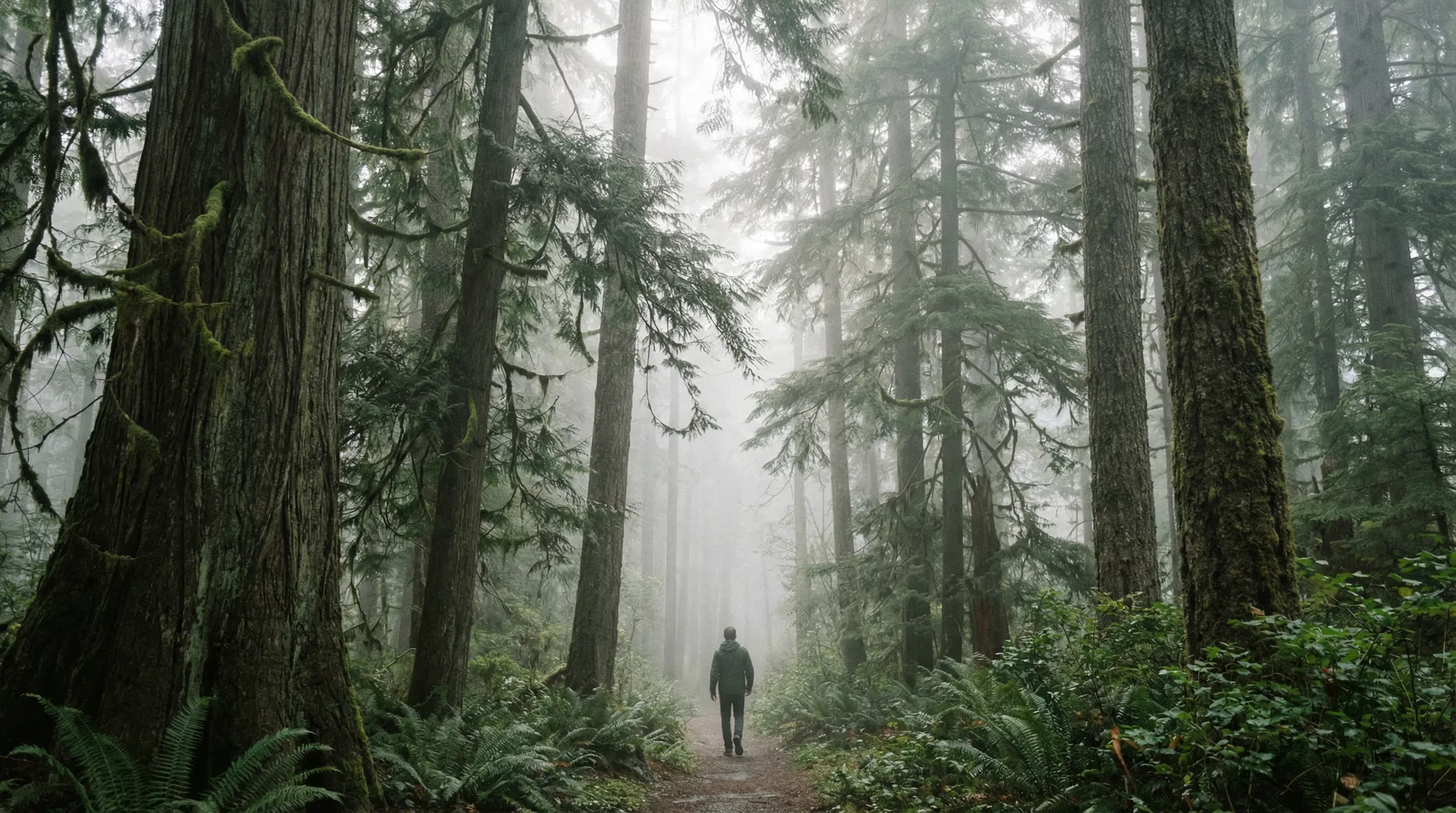
Sunshine Coast, BC
"The forest was here all along. You just needed a reason to walk into it."
WHY UNTRAVELLING MAKES SENSE RIGHT NOW
Let's be honest about the conditions. In 2026, the idea of booking a transatlantic flight and not thinking about the geopolitical situation at your destination requires a level of wilful ignorance that is increasingly difficult to maintain. Active conflicts in multiple regions. Trade barriers reshaping which currencies feel stable at a foreign ATM. The slow erosion of the post-pandemic travel boom as the reality of costs — financial, environmental, emotional — reasserts itself.
And then there is the money. The easy-spending era — low interest rates, cheap flights, the sense that a weekend in Barcelona was an affordable impulse — is over. For a lot of people, discretionary travel is no longer a given. It is a decision. And when something becomes a decision rather than a default, you start asking whether it is actually the right one.
This is not a counsel of despair. It is an invitation. Because the same conditions that make far-flung travel harder also make the case for untravelling more compelling than it has ever been. If you cannot go everywhere, you are forced to go somewhere. And somewhere, it turns out, is usually more interesting than you gave it credit for.
"If you cannot go everywhere, you are forced to go somewhere. And somewhere, it turns out, is usually more interesting than you gave it credit for."
— Just Gerald Magazine
The vitamin D argument is real, by the way. Not sitting on a Hawaiian beach — that is a fantasy, and a fine one — but getting outside, in whatever weather your part of the world offers, and letting your body do what it is designed to do. The research on forest bathing is not soft science. Spending time in old-growth trees measurably lowers cortisol, reduces anxiety, and improves mood. You do not need to fly to Japan to practice shinrin-yoku. You need a forest. Most of us live within an hour of one.
— Advertisement —
WHAT UNTRAVELLING ACTUALLY IS
Untravelling is not staying home because you have no choice. It is staying home — or staying near home — because you have made a choice. A deliberate one. It is the decision to apply the same quality of attention you would give to a new city to the place you already live. To walk down a street you have walked a hundred times and actually look at it. To eat at the restaurant you have been meaning to try for two years. To take the ferry to the next town over and spend a day there as if you had never been.
It is also, and this is the part that takes longer to arrive at, a practice of emotional presence. Travel, at its worst, is a way of running from something. The dissatisfaction with your job, your relationship, your city, your life. You go away and for a week you feel like a different person — lighter, more curious, more alive. And then you come home and the same things are waiting. The untraveller asks: what if I brought that quality of attention home with me? What if I stopped waiting for the next trip to feel like myself?
On the Sunshine Coast, this is not a theoretical exercise. It is the way most people here already live, by necessity and by choice. The ferry crossing from Horseshoe Bay is not an inconvenience. It is a filter. It creates a deliberate distance from the city that makes you pay attention to where you are. The old-growth trails behind Roberts Creek. The tide pools at low water. The coffee at the place in Gibsons where the owner knows your name. These are not consolation prizes for people who cannot afford to go somewhere better. They are the thing itself.
ATTENTION
The same quality of noticing you bring to a new city, applied to the place you already live. Walk slowly. Look up. Order the thing you haven't tried.
PRESENCE
Stop waiting for the next trip to feel like yourself. The life you are living right now is the one worth paying attention to.
PROXIMITY
The best day ever is usually within an hour of where you are. You just haven't gone looking for it yet.
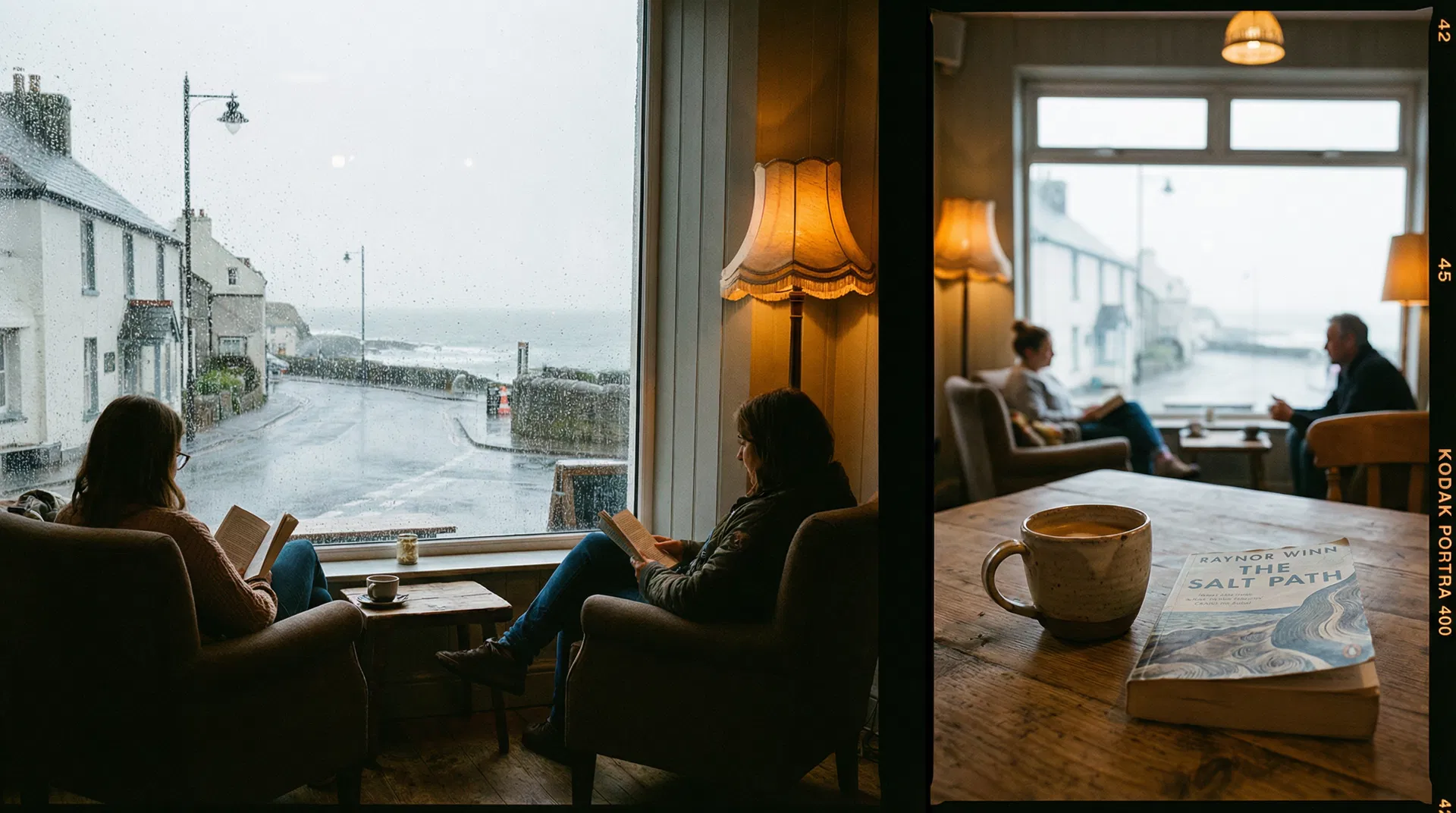
The Local Cafe
Rain on the window. A good book. Coffee that someone made with care. This is not a compromise. This is the point.
HOW TO UNTRAVELL
TAKE THE FERRY YOU'VE NEVER TAKEN
If you live near water, there is almost certainly a ferry route you have never used for pleasure. Book a return ticket. Bring nothing but a jacket and a good appetite. Arrive somewhere small and spend the day there as a tourist.
WALK SOMEWHERE YOU NORMALLY DRIVE
The route you drive every day is a different place on foot. The details that blur at 60km/h — the old building, the garden, the view through a gap in the trees — become visible again. Give yourself two hours and no destination.
EAT SOMEWHERE YOU'VE BEEN MEANING TO TRY
There is a restaurant in your town that you have driven past a hundred times and never entered. Go tonight. Order something you wouldn't normally order. Pay attention to the room.
GO OUTSIDE IN BAD WEATHER
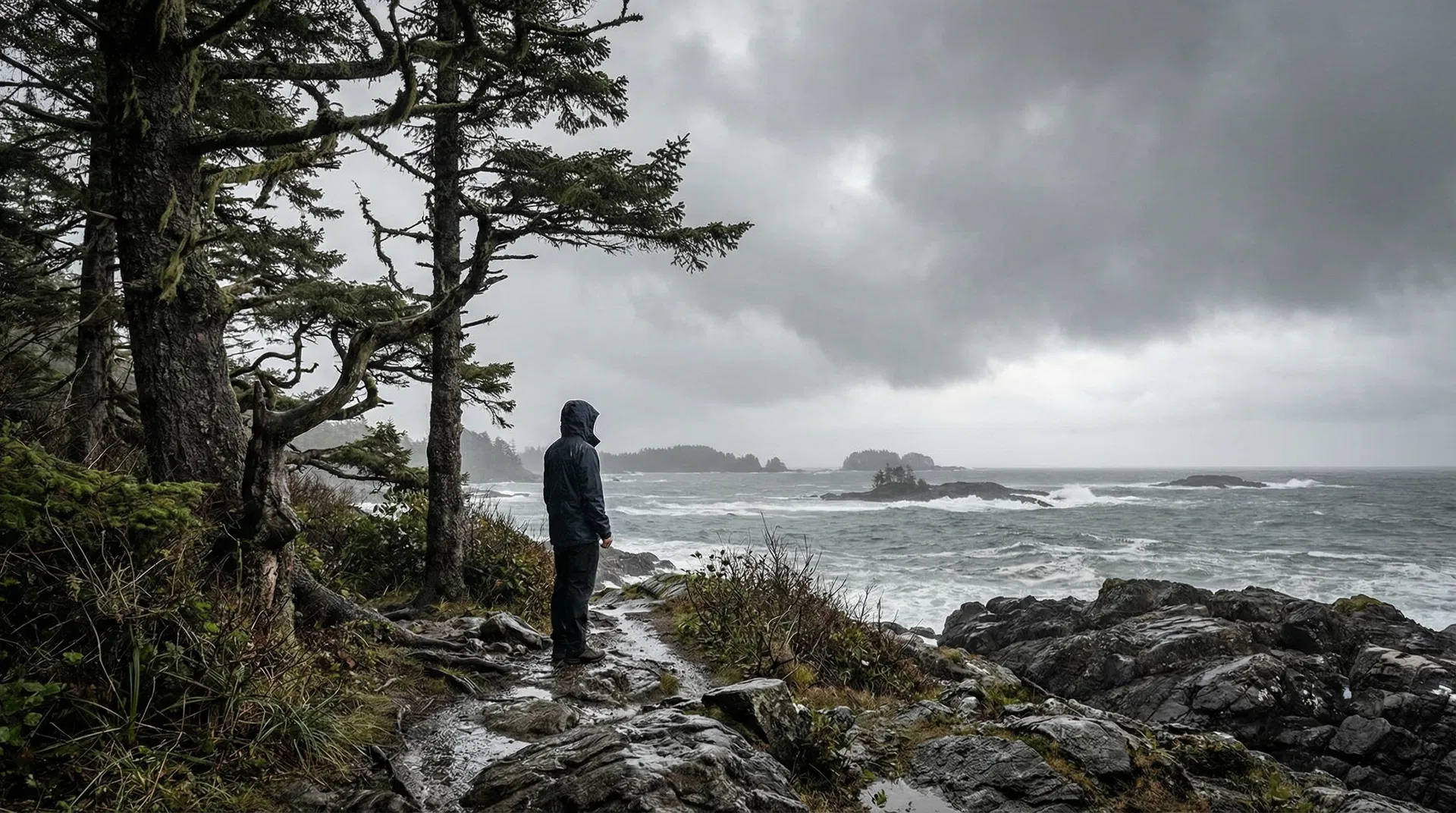
The best version of your local landscape is often the one nobody else is bothering with. A stormy beach. A forest trail in the rain. The town at dusk in November. These are not the Instagram versions. They are the real ones.
BOOK A NIGHT SOMEWHERE NEARBY
One night in a small hotel or B&B in the next town over changes everything. The act of packing a bag, checking in, and waking up somewhere slightly unfamiliar is enough to reset the brain. You do not need to go far.
LEARN SOMETHING ABOUT WHERE YOU LIVE
The history of your street. The name of the mountain you can see from your window. The story of the building that burned down. Every place has a past that most people who live there have never looked into. Start looking.
— Advertisement —
FINDING PEACE WITH WHERE YOU ARE
There is a harder version of untravelling that has nothing to do with day trips and local restaurants. It is the emotional work of learning to be at peace with your actual life — not the life you are going to have once you get to the good part, but the one you are living right now, in this house, in this town, in this season.
Travel, at its most honest, is a mirror. You go somewhere new and you see yourself differently — or you see what you have been avoiding. The untraveller has to do that work without the mirror. Without the novelty and the distance and the convenient excuse of being somewhere else. It is harder. It is also more durable.
The darkness of winter is a real thing. The short days and the grey skies and the vitamin D deficit are not imaginary. They are physiological. But they are also, if you let them be, an invitation. The Japanese have a word — ma — for the productive pause, the meaningful gap, the space between things. Winter is ma. The dark months are not the absence of the good months. They are their own thing, with their own quality, if you are willing to sit with them.
Get outside anyway. Not despite the weather but because of it. The Scandinavians have been doing this for centuries — the concept of friluftsliv, the open-air life, is not a fair-weather practice. It is a year-round commitment to the idea that the outside world is worth being in, whatever it is doing. Dress for it. Go. Come back. Make something hot to drink. Notice that you feel better.
"The dark months are not the absence of the good months. They are their own thing, with their own quality, if you are willing to sit with them."
— Just Gerald Magazine
The world is complicated right now. It has been complicated before and it will be complicated again. The instinct to escape — to book a flight and put some physical distance between yourself and the news — is understandable. But escape is temporary. The world follows you. The untraveller learns, slowly and imperfectly, to stop running from it and start living inside it.
That is not resignation. It is not giving up on the world or on yourself. It is the harder, quieter, more sustainable version of the same impulse that sends people to airports. It is the decision to be here — fully, attentively, without waiting for somewhere better to arrive. It is, in the end, the best day ever. It just doesn't look like the brochure.
UNTRAVELLING
The practice of finding travel-quality attention close to home
The ferry was running. The trail was wet. The coffee was hot. I walked into the forest and stayed longer than I planned, and when I came out the world felt, if not smaller, then at least more manageable. I drove home the long way. I stopped to look at the water. I thought: this is enough. This is, in fact, exactly enough.
Best Day Ever. Right here.